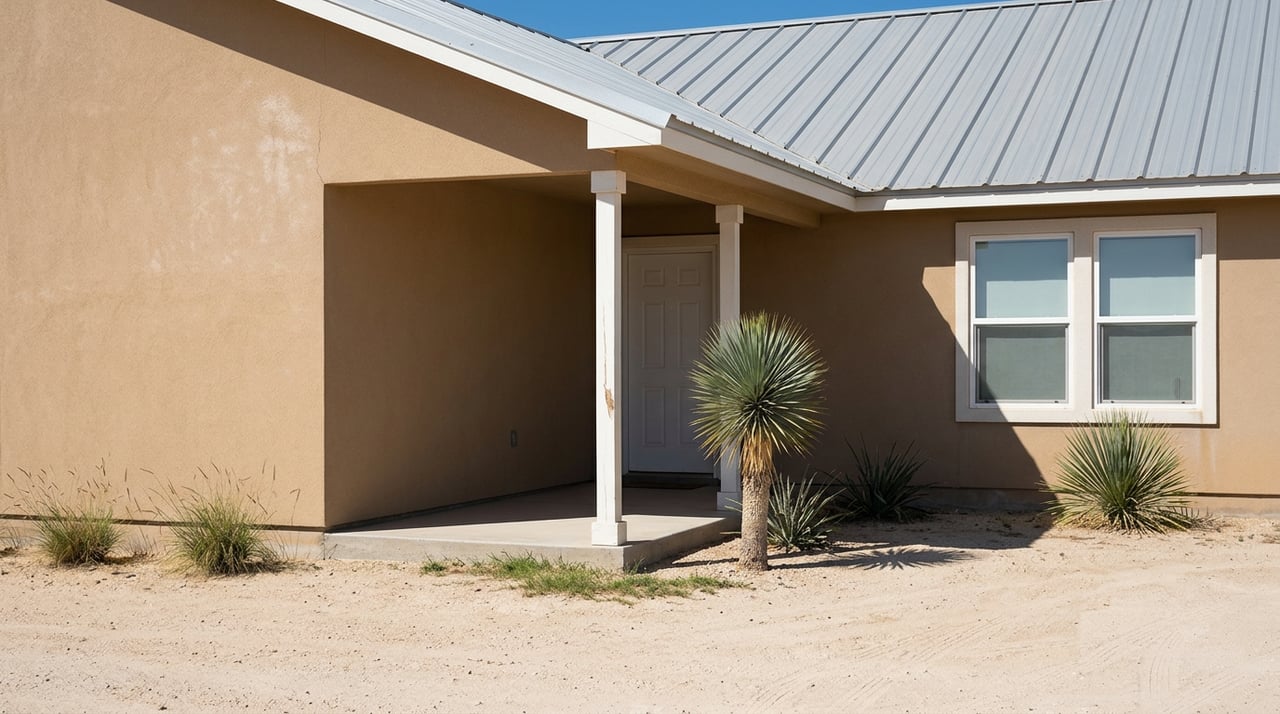
Texico Rural Closings: Why the Well Matters More Than the House Right Now
July 23, 2026
July 23, 2026
Most Texico contracts spend inspection week focused on the roof, the HVAC, and the flooring. That is the wrong emphasis. On a rural parcel outside municipal sewer, the deed conveys a house you can see, but the domestic well and the septic system decide whether anyone can legally occupy it after closing. And for the next five years or so, until Ute Reservoir surface water finally reaches town, the well on your parcel is doing work that no city hookup is going to relieve.
That is the framing this post is built around. If you are under contract on a Texico property, or about to write on one, treat the water and waste documents as the transaction. Everything else is finish work.
Texico is a member community of the Eastern New Mexico Water Utility Authority, which has been building a pipeline from Ute Reservoir in Quay County to Clovis, Cannon AFB, Portales, Elida, and Texico. On May 13, 2026, the U.S. Bureau of Reclamation awarded ENMWUA $77 million toward finishing the final large-diameter segments. Board Chair Mike Morris said in the announcement that the system is on track to begin delivering renewable surface water within the next five years. On July 1, 2026, the ENMWUA board approved the construction bid package for that last pipeline phase and turned its attention to funding a water treatment plant, whose proposed deep well injection component is still pending review at the New Mexico Environment Department.
Read those two dates together and the practical picture for a Texico buyer is straightforward. Any home closing this summer is going to spend most or all of its early ownership on a private well pulling from the Ogallala Aquifer, which the ENMWUA project scope itself describes as the sole regional source and in steady decline. A 2022 New Mexico Political Report story on the pipeline noted that residents of areas like Texico were already seeing wells go dry. That is the local mechanism working buyers have to price in. A permitted, documented, adequately producing domestic well is not a bonus feature on a Texico listing. It is the reason the parcel is habitable through the end of the decade.
New Mexico's liquid waste rule, 20.7.3 NMAC, is administered by the NMED Construction Programs Bureau, and it changes the shape of a Texico rural closing in three specific ways.
| Rule | What it means at the closing table |
|---|---|
| Pre-conveyance septic inspection | Every septic system outside municipal sewer must be inspected before the property transfers. The inspection typically happens after the property goes under contract. |
| 3/4-acre minimum for a conventional system | If the existing system fails and the lot is smaller than 0.75 acre, a like-for-like replacement is not automatic. Grandfathering only applies to a previously permitted system that passes inspection. |
| 180-day repair window | If the inspection fails, the legal owner at 180 days from that date is on the hook to repair or replace, even if the sale collapses. After that, NMED may red-tag the property and prohibit occupancy. |
A buyer who understands those three rules stops thinking of the septic inspection as pass or fail and starts thinking of it as a document with a countdown clock attached. If the system fails in July, the seller who does not close still owns the problem by January. That reframes the negotiation. The NMED permitting page details what a full permit application then requires, including a site diagram showing structures, wells, boundaries, and setbacks per Table 301.1, a floorplan showing bedroom count for design flow, and either the tax bill or recorded deed as proof of ownership. That is the paperwork your seller may end up assembling on a deadline you inherited.
Design flow drives the drainfield size. The NMED formula runs design flow times two for required square footage. A two-bedroom home at 300 gallons per day needs roughly 600 square feet of drainfield. On sandy, fast-percolating soils common east of Clovis, secondary treatment or disinfection may be required, which increases cost. Installers must hold an MM-1, MM-98, MS-1, or MS-3 license. A homeowner can self-install a simple conventional system only after passing NMED's written exam.
The Office of the State Engineer maintains a public well permit and log database, the Water Rights Reporting System. Before a Texico buyer signs, that database is where the real diligence happens. You are looking for four things. The permit number and issue date, so you know the well is legal. The reported depth and static water level, so you can compare it to nearby wells in the same section. The reported yield in gallons per minute. And the driller's log describing the formation, which tells you what the well is actually drawing from.
A well permitted at 300 feet with a static level at 260 feet is telling you something very different from a well permitted at 180 feet with a static level at 90 feet, even if both currently produce water. In an aquifer that eastern New Mexico has watched decline for decades, headroom between static level and pump setting is the margin that separates a functioning house from a dry-tap call to a driller two summers from now.
Setbacks matter for a replacement well, not just a new build. Statewide OSE guidance requires a new well to sit at least 50 feet from any existing well owned by another party, 50 feet from a septic tank or sewer line, and 100 feet from a drain field or seepage pit. On a small in-town Texico lot with a manufactured home, those setbacks can foreclose a redrill in place. That is a question to answer before earnest money goes hard, not after.
This trips up buyers arriving from states with simpler doctrines. In New Mexico, water rights follow the land only when they are irrigation rights considered appurtenant to the parcel. Domestic well rights, and any commercial or agricultural rights that were adjudicated separately, may or may not transfer with a warranty deed. New Mexico also applies a "use it or lose it" standard, which means an irrigation right that has been dormant for years may be at risk of forfeiture even if it appears on old paperwork.
For a Texico buyer looking at a small acreage listing with a stock tank, a windmill, or a legacy circle pivot on a neighboring quarter, this is not a theoretical concern. Ask the listing side to identify by permit number what water rights are being conveyed, and verify each one against the OSE database. If the answer is vague, that is the answer.
Here is the order the questions should hit your file, once you have an accepted offer.
Handled in that order, most Texico rural closings are calmer than the folklore suggests. Handled in reverse, they are not.
Is the pipeline coming soon enough to skip well diligence? No. ENMWUA's own May 2026 timeline puts first delivery within five years, and the treatment plant is not yet funded. Any home you buy this year will rely on its private well for the foreseeable ownership horizon.
If the septic passes inspection, am I done thinking about it? For now. But keep the inspection report and the permit on file. NMED permit records travel with the property, and a future buyer will ask for them.
Can I close before the septic inspection comes back? That is a question for your title company and lender, and it is rarely a good idea. The 180-day repair liability lands on the legal owner at the time of a failure, and closing early does not extinguish that clock.
If you are working through a contract on a well-and-septic property near the state line, or comparing Texico listings against Clovis or Farwell options, Tammy Waters and The Waters Group at Town & Country Real Estate can walk the well log, the NMED file, and the OSE record with you before you commit. Request your free buyer/seller packet and let's read the documents together.
Explore additional posts offering valuable real estate guidance and local insight.

Partner with Tammy who's dedicated to providing clarity, care, and honesty throughout every step.

TAMMY WATERS
ADDRESS 400 PILE, SUITE 300 CLOVIS NM, 88101